Choosing the best Model Tower Crane starts with its purpose. Is it a display piece, a hands-on building kit, or a radio-controlled model? Those options demand different trade-offs. Collectors may value accurate lattice sections, realistic cab details, and a stable base. Younger builders often need clear instructions, durable connectors, and manageable assembly time. For moving models, check the advertised lifting capacity, rotation, power source, and recommended age. A tall boom looks impressive, but it means little if the base wobbles.
Reliable buying advice should separate measurable features from promotional claims. The U.S. Consumer Product Safety Commission’s annual toy-injury surveillance reports offer useful context for evaluating age guidance and foreseeable play risks. For products sold as toys in the United States, ASTM F963 provides a recognized safety benchmark; buyers should still confirm the specific product’s labeling and intended use. Small details matter. Look closely at exposed gears, pinch points, counterweights, and how securely the tower joins its base. Not just height. Market trend reports can describe demand for construction play, but they cannot establish that one crane is sturdy or enjoyable. A glossy box cannot prove that. Compare independent reviews, replacement-part availability, and warranty terms, then consider whether the model fits the available display or play space. I would treat spectacular load claims cautiously unless the maker explains how they were tested. Even a well-reviewed crane may disappoint if assembly is fiddly or its controls feel imprecise. The best choice balances realism, safety, durability, and the buyer’s actual expectations.
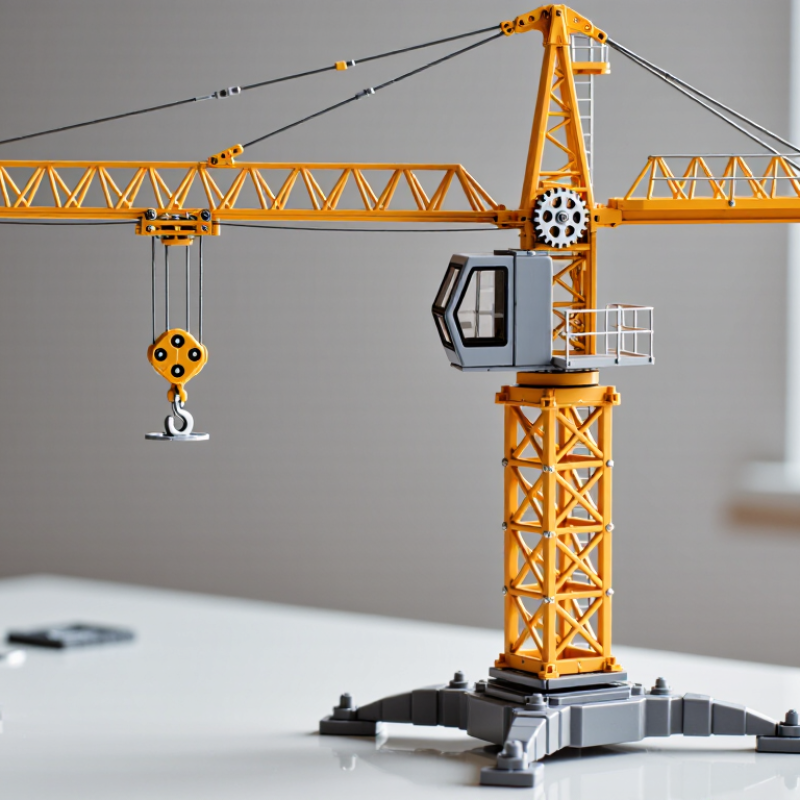
Model tower cranes are commonly sold in compact display scales, such as 1:87, and larger collector scales, such as 1:50.
These ratios are useful comparisons, not a universal quality ranking. Circana’s 2023 U.S. toy retail review reported $28.3 billion in toy sales, down 8% from 2022; it does not break out model tower cranes. Scale changes everything. At 1:50, a longer boom and visible cable routing may make operation easier to inspect, but the model also needs more shelf space.
Material affects both feel and function.
ABS plastic keeps the tower light, while die-cast metal adds weight to the cab or base. Steel or aluminum sections can make a tall mast feel steadier, though loose joints still cause wobble. Small details matter. Operating features range from a hand-cranked hook to powered slewing, trolley movement, and remote control. Compare the stated lifting limit and test whether the hook rises smoothly with a small load. A remote controller adds play value, but can obscure weak gears or imprecise stops. One trade-off is easy to miss: more moving parts can mean more maintenance. Check cable winding, joint fit, and whether the counterweight stays secure before choosing.
A 1:50 model usually suits collectors who want visible machinery detail and have room for a long jib. Consider a representative tower crane with a 60-metre jib and a 50-metre mast. At 1:50, those dimensions become 1.2 metres and 1 metre. That is substantial. Before buying, measure the shelf, including space for the counter-jib and display base. A model’s footprint can exceed its advertised height.
A 1:100 version of the same crane scales to a 60-centimetre jib and 50-centimetre mast. It needs less display space, though small ladders, platforms, and cable details may be harder to see. ISO 4306-1:2007 provides standard crane vocabulary; published technical specifications provide the real dimensions needed for accurate scale comparisons. Check those dimensions rather than relying on box photos, which can hide the jib’s full reach.
The better choice depends on what you want to inspect. At 1:50, individual handrails and cab shapes are easier to appreciate. At 1:100, several cranes or buildings can share one shelf. One detail is easy to overlook: transport boxes and assembly clearance also need space. I would measure twice. I would also leave room for the jib to turn, if the model allows it. Scale alone cannot tell you how sturdy a finished display will feel.
Compare 1:50 and 1:100 scales for display space and detail
Based on a representative full-size crane with a 60 m tower and a 50 m jib. At 1:50, the scaled dimensions are about 120 cm tall and 100 cm long; at 1:100, about 60 cm tall and 50 cm long. These are scale calculations, not specifications for a particular model. A 1:50 model offers more room for visible detail but needs substantially more display space; 1:100 is more compact.
A tower crane’s headline capacity can be misleading. Check the rated load chart for the planned jib length and lifting radius. Maximum capacity is often available close to the mast, while capacity falls toward the jib tip. A 2-ton load may be manageable at one position and unsuitable just a few metres farther out. Include the hook block, lifting gear, and load weight in your calculations. Small details matter.
Reach should match the site, not just the project’s largest lift. Compare the working radius with the ground-level delivery area, building footprint, and places where materials must land. Then review rotation: does the crane provide the required slewing range, and can it turn without crossing obstacles or conflicting with nearby equipment? Rated rotation speed also affects how carefully loads can be positioned. Faster is not always better.
Compare specifications for the exact configuration you plan to use, including jib length, mast height, and reeving arrangement. A chart for a different setup is not a safe substitute. Check foundation and tie-in requirements with qualified lifting professionals. Paper figures can look neat. Real sites rarely are. One awkward delivery point may change which crane is the better fit.
A tower crane toy can look sturdy on a shelf, yet its moving parts deserve close attention. For toys sold in the United States, ASTM F963-23 sets safety requirements covering mechanical and physical hazards, among other areas. 16 CFR Part 1250 incorporates the toy standard into federal rules. Check that the specific model was evaluated against the applicable requirements, not just described as “tested.” Small detachable hooks, loose counterweights, sharp edges, and pinch points around the rotating cab are worth inspecting. Look at the stated age range, too; tiny parts may pose a risk to younger children.
Ask the seller or manufacturer for a Children’s Product Certificate and supporting test information, including third-party testing from a CPSC-accepted laboratory where required. The records should identify the product and the standard used. Then inspect the actual toy: turn the boom slowly, check that the base stays steady, and look for cracked plastic or exposed fasteners. A certificate helps, but it cannot reveal every flaw in a sample. Even careful buyers can miss one. That is a reason to check again after assembly and during regular play.
What Is the Best Model Tower Crane to Buy?
A low purchase price can hide expensive gaps. Compare cranes with the same lifting capacity, jib length, mast height, and control package. Then request an itemized quote covering transport, assembly, commissioning, and operator training. A crane that costs less upfront may require costly add-ons before it can work on site. Check the delivery schedule, too. A late mast section can hold up an entire lift plan.
Spare-part availability matters when a crane is working far from a service center. Ask for a parts list with prices and realistic delivery times for hoist motors, brakes, limit switches, and wire ropes. Find out which items are held locally and which ship from overseas. Ask whether compatible parts remain available after the model is discontinued. Get the answer in writing. A vague promise of “fast support” is hard to use when a crane is idle.
Warranty terms deserve a close read. Confirm which structural and electrical components are covered, whether labor and travel are included, and when coverage begins. Shipment and commissioning dates can differ by weeks. Check the exclusions for wear parts, poor maintenance, and damage during installation. Request a sample claim process and the nearest service contact. I would still allow for some uncertainty: contract wording may not reflect how quickly a difficult claim gets resolved. Compare the documents, not just the sales pitch.
| Crane Configuration | Typical Rated Capacity | Indicative New-Equipment Price (USD) | Spare-Part Availability | Warranty Coverage to Check | Best Fit |
|---|---|---|---|---|---|
| Self-erecting tower crane | About 1–4 metric tonnes | Approximately $100,000–$300,000 | Often good for standard electrical and hydraulic items; specialized components may require ordering. | Terms vary by supplier. Confirm coverage for the structure, motors, electrical systems, labor, and travel, as well as the start date and claim process. | Low- to mid-rise work, smaller sites, and projects that benefit from faster setup and relocation. |
| Hammerhead tower crane | About 6–12 metric tonnes | Approximately $250,000–$700,000 | Common wear items and standard components may be easier to source; availability depends on the supplier’s local stock and support network. | Request written limits for parts and labor, exclusions for wear items, and the warranty period after commissioning or delivery. | General building construction where a conventional jib arrangement suits the site. |
| Flat-top tower crane | About 6–16 metric tonnes | Approximately $300,000–$900,000 | Availability can be favorable where mast sections and compatible components are standardized; confirm compatibility before relying on shared parts. | Check whether coverage includes the trolley, hoist, slewing system, controls, and replacement-part freight. | Sites with multiple cranes, limited headroom, or a need for simpler jib assembly. |
| Luffing-jib tower crane | About 8–20 metric tonnes | Approximately $500,000–$1,500,000+ | Specialized jib, luffing, and control components may have longer lead times; local technical support is especially important. | Verify coverage for luffing mechanisms and controls, commissioning support, response times, and access to qualified service technicians. | Dense urban sites where reduced out-of-service radius or restricted airspace is important. |
Price ranges are broad planning estimates for new equipment, not quotations. Actual prices vary with capacity, jib length, tower height, configuration, taxes, freight, installation, and market conditions. Warranty terms and spare-part availability are supplier-specific; obtain the current written offer and parts lead-time commitments before purchasing.
Maximum capacity is often available near the mast. Capacity drops toward the jib tip. Check the load chart.
Include the load, hook block, and lifting gear. A 2-ton load may be suitable near the mast but not farther out.
Compare its working radius with the delivery area, building footprint, and material landing points. One awkward drop-off point can change the best fit.
Check the required slewing range and nearby obstacles. Rotation speed affects positioning. Faster is not always better.
Match jib length, mast height, and reeving arrangement to the load chart. A chart for another configuration is not a safe substitute.
Request itemized costs for transport, assembly, commissioning, and operator training. Check delivery dates too. A late mast section can delay work.
Ask for prices and realistic delivery times for motors, brakes, limit switches, and wire ropes. Confirm which parts are held locally. Get it in writing.
Confirm covered components, labor, travel, start dates, and exclusions. Request a sample claim process and nearby service contact. I would still allow for uncertainty.
Choosing the best Model Tower Crane starts with deciding how it will be used: as a display piece, an interactive toy, or a more detailed operating model. Compare scale, construction materials, and features such as motorized movement, remote control, and movable components. A 1:50 model generally offers more visible detail but needs more room, while a 1:100 version is easier to display in a smaller space. Check the model’s dimensions and assembly requirements before buying.
For operating models, compare rated lift capacity, reach, and rotation rather than relying on appearance alone. If the crane is intended for children, review the manufacturer’s safety information and check whether the product is tested against ASTM F963-23 and 16 CFR Part 1250. Finally, consider the total price, availability of replacement parts, and warranty coverage. The right choice balances scale, practical features, safety information, and long-term value with the space and budget available.

Dazheng Crane