Choosing the right Tower Crane Rc model requires more than comparing height, color, or lifting claims. Global buyers must examine control range, motor strength, battery design, assembly quality, and spare-part access. A compact crane may suit a classroom display. A larger radio-controlled model may better represent a construction-site workflow, with rotating jibs, moving hooks, and adjustable loads.
Construction safety expert Dr. John W. Hinze has often emphasized, “A safe project requires planning, supervision, and control.” That principle also applies to Tower Crane Rc selection. Buyers should inspect every control function before purchase. Does the remote respond smoothly? Can the hook stop accurately? Does the base remain stable during rotation? Small weaknesses become obvious when the crane lifts a heavy miniature load.
This guide compares ten Tower Crane Rc types for international buyers. It considers beginner-friendly kits, professional demonstration models, engineering sets, and display-focused designs. Each type has strengths. Each has limits. Some offer impressive movement but weak durability. Others look simple yet provide reliable operation.
Real buying decisions are rarely perfect.
Specifications may be unclear. Online images can mislead. Regional voltage, shipping conditions, and replacement parts also matter. A thoughtful buyer should measure available space before ordering. A two-meter jib can dominate a small room. Noise and assembly time deserve attention too.
The following overview aims to make comparison easier. It does not treat one crane as universally superior. Instead, it connects design, performance, usability, and long-term value. That balanced approach helps buyers choose a Tower Crane Rc model with fewer surprises.
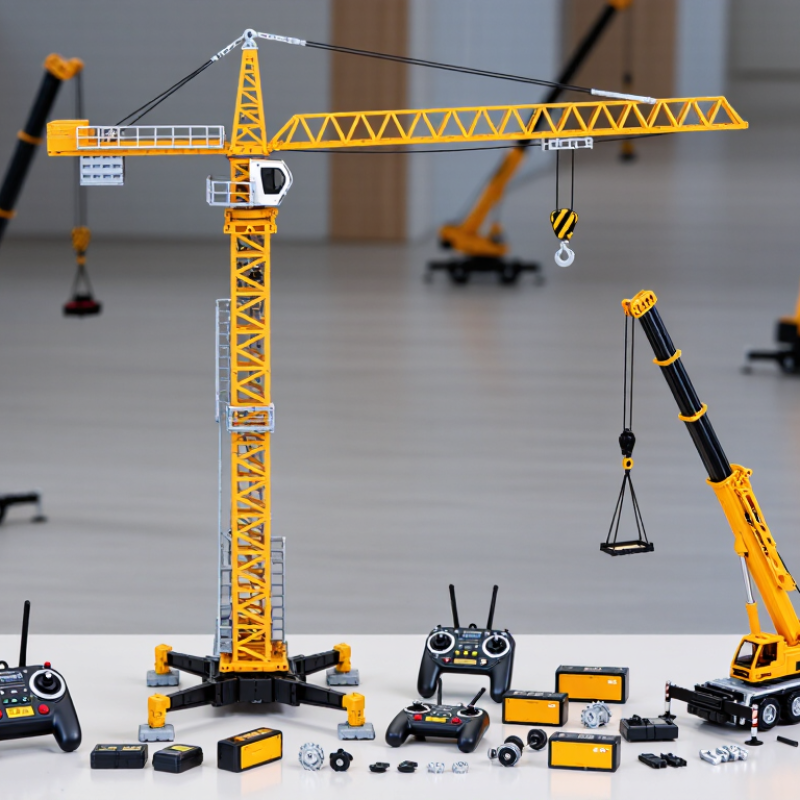
Top 10 Tower Crane RC Types for Global Buyers
RC usually means remote control in tower crane discussions. It is not a universal technical classification. Some suppliers use RC for remote-controlled operation, while others describe a specific control package. Buyers should confirm the meaning in the technical specification, not rely on the abbreviation alone.
The ten common types are hammerhead, flat-top, luffing-jib, self-erecting, mobile tower, rail-mounted, climbing, internal-climbing, telescopic-mast, and portable mini tower cranes. These can be compared through three core classifications: jib design, erection or mobility method, and operating control. Fixed-jib models suit open sites. Luffing-jib cranes work better beside tall buildings. Self-erecting units reduce setup time on smaller projects. Rail-mounted and mobile types offer relocation flexibility. Climbing cranes grow with the structure.
Remote operation can improve visibility near congested foundations. It does not replace a trained operator. Buyers still need verified load charts, wind limits, emergency-stop functions, and signal reliability. During site reviews, I check handset response around concrete walls and steel frames. Small delays matter. A neat category list can mislead, because one crane may fit several groups. The specification should state lifting capacity, maximum radius, foundation requirements, and control distance clearly. Cheap remote systems may look attractive, but poor feedback can create operational uncertainty. That detail deserves more attention.
“RC” commonly refers to remote control operation. Tower cranes can also be grouped by structural configuration, mobility and erection method, and climbing arrangement.
The chart compares representative maximum jib lengths in metres. Actual specifications vary by model, duty class, wind conditions, load charts and local regulations. The three core classifications shown are structural configuration, mobility/erection method, and climbing arrangement.
For global buyers, tower crane capacity should be judged by the load chart, not the headline rating. A 5-tonne model may lift 5 tonnes only near its minimum working radius. At 50 metres, its safe capacity may fall below 1.5 tonnes. This difference matters when placing concrete skips, steel beams, or prefabricated wall panels.
A 10-tonne crane often suits mid-rise residential projects, but configuration changes everything. Mast height, jib length, counterweight, and anchoring affect real performance. A typical 12-tonne class crane may handle 12 tonnes at 20 metres, yet lift only 3 to 4 tonnes at 60 metres. Buyers should request the complete load chart, not a single maximum figure. Check hoisting speed, trolley reach, wind limits, and foundation reactions as well.
Models rated at 16 to 20 tonnes are useful for heavier industrial modules and large formwork systems. Their stronger structure can increase transport, erection, and foundation costs. I have seen capacity comparisons fail because teams ignored dynamic loads during slewing. Small errors become expensive. A safer review compares maximum load, load at maximum radius, duty class, and site wind conditions. The numbers may still need revision after a geotechnical survey. That is normal. A practical procurement sheet should record every assumption, including lifting frequency, shift length, and the heaviest load’s center of gravity.
| Rank | Generic RC Type | Rated Maximum Load | Typical Load at Maximum Jib | Typical Jib Length | Typical Freestanding Height | Common Mast Section | Typical Hoisting Speed | Typical Slewing Speed | Recommended Applications |
|---|---|---|---|---|---|---|---|---|---|
| 1 | 5-tonne compact flat-top tower crane | 5 t | 1.0 t at 50 m | 35–50 m | 30–45 m | 1.6–1.8 m square | 40–80 m/min | 0–0.8 rpm | Residential buildings, small commercial projects and urban renovations |
| 2 | 6-tonne luffing-jib tower crane | 6 t | 1.2 t at 45 m | 25–45 m | 35–60 m | 1.6–2.0 m square | 50–90 m/min | 0–0.7 rpm | Restricted urban sites, high-density construction and projects near obstacles |
| 3 | 8-tonne hammerhead tower crane | 8 t | 1.3 t at 60 m | 40–60 m | 40–70 m | 1.8–2.0 m square | 50–100 m/min | 0–0.8 rpm | Mid-rise residential, hotels, schools and general reinforced-concrete work |
| 4 | 8-tonne flat-top tower crane | 8 t | 1.5 t at 55 m | 35–55 m | 45–75 m | 2.0 m square | 60–100 m/min | 0–0.8 rpm | General building construction and sites requiring simple transport and erection |
| 5 | 10-tonne hammerhead tower crane | 10 t | 1.2 t at 60 m | 45–65 m | 50–80 m | 2.0–2.2 m square | 60–120 m/min | 0–0.8 rpm | Large residential complexes, commercial buildings and precast component handling |
| 6 | 10-tonne luffing-jib tower crane | 10 t | 1.5 t at 50 m | 30–50 m | 60–100 m | 2.0–2.2 m square | 60–120 m/min | 0–0.7 rpm | Tall urban buildings, narrow sites and projects with overlapping crane zones |
| 7 | 12-tonne flat-top tower crane | 12 t | 1.5 t at 65 m | 50–65 m | 55–90 m | 2.0–2.5 m square | 70–120 m/min | 0–0.8 rpm | Major commercial developments, infrastructure buildings and heavy formwork operations |
| 8 | 14-tonne hammerhead tower crane | 14 t | 1.7 t at 70 m | 50–70 m | 60–100 m | 2.2–2.5 m square | 70–130 m/min | 0–0.8 rpm | High-volume concrete construction, industrial buildings and large infrastructure projects |
| 9 | 16-tonne heavy-duty tower crane | 16 t | 1.8 t at 70 m | 50–70 m | 65–110 m | 2.4–2.8 m square | 70–140 m/min | 0–0.7 rpm | Heavy precast panels, bridge-related structures, power facilities and industrial construction |
| 10 | 20-tonne heavy-lift luffing-jib tower crane | 20 t | 2.0 t at 60 m | 35–60 m | 80–140 m | 2.5–3.0 m square | 60–120 m/min | 0–0.6 rpm | High-rise construction, major infrastructure, industrial plants and heavy modular installation |
Global buyers comparing the top 10 tower crane RC types should begin with reach and height data. A 30–80 m jib range covers many urban and industrial projects. Flat-top configurations suit open sites with multiple cranes. Luffing-jib cranes work better near airports, towers, and restricted boundaries. Self-erecting models support smaller sites but usually offer less height. Freestanding builds can exceed 100 m when the foundation, mast, and wind conditions allow it. However, a longer jib does not automatically mean better performance.
Tips: Measure the furthest lifting point, not only the site width. Check rated capacity at the jib tip and near the mast. Confirm foundation loads with a qualified engineer. Leave room for wind movement and future building height. Small errors become expensive.
In practical procurement, compare each RC type through load charts, maximum hook height, transport sections, and tie-in requirements. A 60 m jib may appear ideal, yet its tip capacity could be unsuitable for heavy panels.
A 100 m freestanding crane may reduce climbing work, but it demands careful ground assessment. Operators also need clear controls, reliable visibility, and documented inspection routines. I would not trust a single catalogue figure. Actual performance changes with wind, counterweight selection, installation quality, and site congestion. Even experienced teams sometimes overestimate usable reach. That deserves a second review before purchase.
Safety decisions should begin with standards, not attractive specifications. For remote-controlled tower cranes, EN 14439 addresses design, installation, operation, and dismantling risks. It also supports practical checks around guarding, controls, stability, and foreseeable misuse. A clear load chart must match the crane’s actual configuration.
ISO 4301-3 helps buyers classify tower cranes by working conditions and expected load cycles. This matters when comparing an occasional light-duty crane with equipment handling concrete every day. Record the duty class, maximum radius, rated load, and wind limits. Small details matter. A 5-ton rating means little without its working radius.
ASME B30.3 provides another important safety reference, especially for projects influenced by North American practice. It covers inspection, operation, maintenance, and personnel responsibilities. The exact edition and local requirements should be verified before procurement. Standards are not interchangeable certificates. A crane may satisfy one framework while needing additional assessment elsewhere.
Experienced buyers should request manuals, inspection procedures, structural calculations, and configuration drawings. Check emergency stop functions at the control station. Inspect limit switches, brakes, ropes, hooks, and anchorage points. Ask how software updates affect remote controls. This is often overlooked. Site conditions can expose weaknesses that factory tests never show. A checklist can still miss poor communication between the operator and signal person. That risk deserves honest review.
Global buyers should match the remote-control (RC) system to the site, wind exposure, and duty class, not merely its purchase price. The ten practical types are: basic handheld, proportional-joystick, two-joystick, belly-box, pendant backup, dual-operator, telematics-enabled, anti-collision-integrated, cab-remote hybrid, and heavy-duty multi-function RC. A small residential site may suit a basic handheld unit. A high-rise site needs proportional control, anti-collision communication, and reliable signal monitoring. Tight urban projects benefit from a belly-box design, because operators can walk around blind corners while maintaining visual contact.
Wind changes the decision. Open coastal sites require strong signal stability, weather-resistant housings, and clear alarm feedback. Sheltered sites may accept simpler controls, but that assumption deserves review. EN 14439 and ISO 9927 emphasize crane safety, inspection, and operating conditions. The International Labour Organization reported 2.93 million work-related deaths annually in its 2023 safety assessment, reinforcing the value of controlled lifting procedures. RC selection cannot remove human error.
Duty class matters more than many buyers expect. Frequent material handling favors proportional joysticks, dual-operator coordination, and telematics records. Intermittent low-duty work may need only a handheld unit with emergency-stop protection. FEM crane classification guidance helps buyers compare operating frequency and load spectrum. The 2023 Global Wind Report also highlights increasingly demanding wind conditions across exposed infrastructure projects. Data is useful, but local wind records are better. One overlooked issue is glove usability. Test every control in rain, dust, and winter clothing before approval.
The headline capacity shows only the maximum rating. A 5-tonne crane may lift 5 tonnes near its shortest radius. At 50 metres, its safe capacity might fall below 1.5 tonnes. Check capacity at every planned lifting distance.
A 10-tonne model may suit many mid-rise residential projects. However, mast height, jib length, counterweight, and anchoring change performance. At 20 metres, it might lift 12 tonnes in its class. At 60 metres, capacity may fall to 3 or 4 tonnes. The numbers need checking.
These cranes suit heavy industrial modules and large formwork systems. Their stronger structures can increase transport, erection, and foundation costs. Dynamic loads during slewing must be included. Small errors become expensive.
Request the complete load chart, configuration drawings, manuals, and structural calculations. Also request inspection procedures and foundation reaction data. Check hoisting speed, trolley reach, wind limits, and duty class. One maximum figure is not enough.
Recognized safety standards guide design, installation, operation, inspection, and dismantling. They also address guarding, stability, controls, foreseeable misuse, and personnel duties. A certificate from one framework may not satisfy local requirements. Verify the exact edition and local rules.
Inspect emergency stops, limit switches, brakes, ropes, hooks, and anchorage points. Test the remote control from realistic working positions. Check whether software updates change control behavior. Factory testing may not reveal site weaknesses.
A basic handheld unit may suit intermittent, low-duty lifting. It should include emergency-stop protection and clear alarm feedback. A tight urban site may need a wearable control design. Operators can move around blind corners while keeping visual contact. That benefit is practical.
Exposed coastal sites need stable signals and weather-resistant housings. They also need clear wind alarms and reliable communication. Sheltered sites may accept simpler equipment, but that assumption requires review. Local wind records are more useful than broad reports.
Frequent concrete handling favors proportional joysticks, coordinated operators, and telematics records. Intermittent work may need only simpler controls with emergency-stop protection. Record lifting frequency, shift length, and the load spectrum. A cheap choice can become unsuitable quickly.
Test every control in rain, dust, and winter clothing. Check glove usability, signal-person communication, and operator visibility. Remote control cannot remove human error. The checklist may still miss poor communication. That risk deserves honest review.
This guide explains what “RC” can represent in tower crane specifications and organizes ten common Tower Crane Rc types into three core classifications based on configuration, mobility, and operating duty. It compares typical load capacities from 5 to 20 tonnes, helping buyers understand how rated load, lifting moment, and working radius affect practical performance. The overview also examines jib lengths of approximately 30–80 meters and freestanding construction heights exceeding 100 meters, while emphasizing that actual results depend on site conditions, foundation design, and configuration.
Safety and compliance are central to responsible selection. The guide introduces EN 14439, ISO 4301-3, and ASME B30.3 as useful references for design, inspection, classification, and operation. For global buyers, the best choice should match the project’s site layout, wind exposure, required reach and height, lifting frequency, duty class, installation method, and local regulatory requirements. A structured comparison can support safer planning, more accurate budgeting, and reliable long-term performance.

Dazheng Crane